Front Desk, Independent Manager or Self Managed: How to Rent Out a Maui Condo in 2026
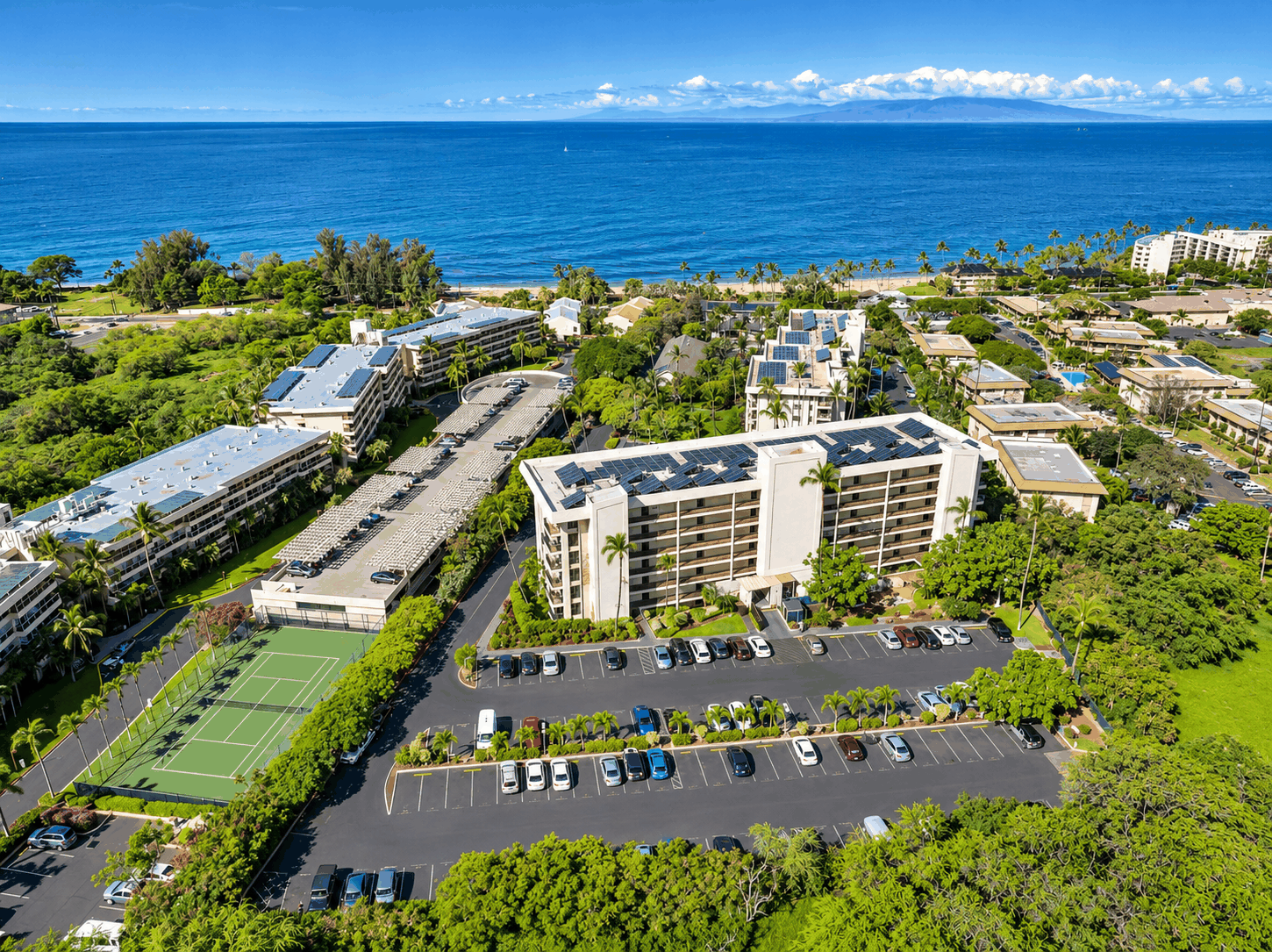
Kihei Akahi on South Kihei Road, across the street from Kamaole Beach Park II. It is hotel zoned, so it sits outside the Bill 9 phase out, and it is home to my new listing, Kihei Akahi D402. Listed with Jeremy Stice of Hawaii Life.
How you rent out a Maui condo matters as much as which condo you buy. Two buyers can pay the same price for the same floor plan in the same building and end up with very different returns, very different vacations and very different amounts of work, all because of the rental method each one picked.
I first wrote about this years ago. A lot has changed since then. The August 2023 fires. Bill 9. A brand new hotel zoning path. A higher tourism tax. A bigger Airbnb fee. And a Maui condo market that has reset hard enough to bring buyers back.
So this is the 2026 version, rebuilt from the ground up.
Where I Sit on Maui Vacation Rentals
Over my career, I have represented dozens of vacation rental buyers and sellers across Maui. I serve as President of the Board of HIMAST (the Hawaii Mid and Short Term Rental Alliance), and my past roles include President of the Board of the Maui Vacation Rental Association. Megan and I also own and operate a vacation rental at Hoolei in Wailea, so the rules below are rules I live under too.
My job is to point you to the rental method that fits your goals, whichever one that turns out to be. For some clients that is a resort front desk program. For others it is an independent manager, or doing it themselves.
Three Questions Every Maui Condo Buyer Should Answer First
- Net cash flow. What do you need the property to earn each year after management fees, operating costs, property tax, insurance and any financing, and how does that compare with the cash you put in?
- Personal use. How many weeks a year do you want to be there yourself, and how far ahead can you plan them?
- Involvement. Do you want a monthly statement and nothing else, or do you want to control the calendar, the pricing and the guest experience?
Hold on to your answers. Every section below comes back to them.
What Is in This Article
- Why Maui Still Works for Vacation Rental Owners in 2026
- The 2026 Maui Condo Reset and Why It Favors New Buyers
- Check the Zoning on Any Maui Condo Before You Pick a Rental Method
- The Three Ways to Rent a Maui Condo, Side by Side
- How Maui Resort Front Desk Rental Programs Work
- Hiring an Independent Maui Vacation Rental Manager
- Self Managing a Maui Vacation Rental in 2026
- Matching a Maui Rental Method to Your Goals
- Thinking About Buying a Maui Vacation Rental in This Reset?
- Frequently Asked Questions About Renting Out a Maui Condo
Why Maui Still Works for Vacation Rental Owners in 2026
Start with demand, because every rental method depends on it.
According to the state Department of Business, Economic Development and Tourism (DBEDT), Maui welcomed 2,516,163 visitors in 2025, up 7.0% from 2024. Those visitors spent $5.97 billion on Maui, up 12.7%. Statewide, arrivals were flat, at 9.64 million visitors, down 0.6%.
Twenty eight months after the fires, Maui was the part of Hawaii that was growing.
West Maui is part of that recovery. DBEDT reported hotel occupancy in the Lahaina, Kaanapali and Kapalua region at 66.2% in July 2025, up from 57.9% a year earlier.
The Honest Headwind for Maui Vacation Rentals
Vacation rental occupancy has not kept pace with hotels. In September 2025, DBEDT’s vacation rental report showed Maui County vacation rentals at 40.1% occupancy with an average daily rate of $467, while Maui County hotels ran 59.3% occupancy.
September is a slow month on Maui, and peak season looks very different. But the gap tells you this is a more competitive rental market than it was a few years ago, and the rental method you choose matters more because of it.
Occupancy varies widely by building, unit type, season, pricing and management. In the condos I see, well-run Maui vacation rentals still reach 75 to 80 percent average annual occupancy, though often at lower nightly rates than a few years ago.
Maui Has Always Been an Equity Market
Owning on Maui has never been cheap. Property tax, association dues and insurance run high. Most of the owners I work with treat Maui as a long term real estate and lifestyle hold, with rental income helping carry the costs. Whether it works financially comes down to the price you pay, your financing, your operating costs, how the unit rents and what you eventually sell for.
That math depends heavily on what you pay going in, which is why the 2026 reset matters so much. For building by building prices in the luxury resorts, see my Maui Luxury Vacation Rental Index.
The 2026 Maui Condo Reset and Why It Favors New Buyers
Here is the part of the market most people are still catching up to.
According to the Realtors Association of Maui, the Maui County condo median was $920,000 in October 2024. By October 2025 it was $625,750, a 32% drop in one year.
Kihei tells the same story. In my own analysis of Realtors Association of Maui data, the Kihei condo median went from $771,500 in 2024 to $655,000 in 2025, then $600,000 for 2026 through August.
Maui Condo Buyers Are Already Coming Back
Buyers have noticed. In September 2026, Maui County recorded 72 condo sales, up 56.5% from 46 in September 2025, and the median edged up to $660,000 from $652,500.
Monthly medians swing with the mix of what sells, and these are different measures, so I would never hang a forecast on any one of them. Taken together, they point to a real repricing in the Maui condo market and stronger buyer activity this fall. One strong month does not prove a sustained recovery, but it is the kind of signal I watch for.
This is the strongest buying opportunity for Maui vacation rental condos I have seen in years. Prices have come down, sellers are negotiating, and the rules that scared everyone off are now written into law with dates attached.
Why This Reset Is a Real Opening for New Buyers
- The rules are known now. Much of the price drop happened while Bill 9 was still a proposal. Today the deadlines are law, so you can price them instead of guessing at them
- Sellers are negotiating. In a market with more inventory and fewer bidders, price is only one lever. Credits, closing dates, furnishings and the handling of existing bookings are all on the table
- The discount is deepest where the risk is highest. In my Kihei analysis, Minatoya list 2 bedrooms carried 15.5 months of supply, against 9.1 months for hotel zoned 2 bedrooms and 4.4 months for 2 bedrooms in buildings that do not allow vacation rentals. Buyers are pricing in the phase out
- Different buyers win in different buildings. A rental investor, a second home buyer and a future retiree should be shopping in different parts of this market
Where the Opportunity Sits for Each Maui Buyer
- Rental investors: hotel zoned buildings keep their vacation rental rights under Bill 9, and you are buying them in a market where sellers are motivated
- Second home and long term rental buyers: Minatoya list buildings are trading at deep discounts, and they can make sense if your plan does not depend on nightly rentals past the deadline
- Rezoning upside buyers: Minatoya list buildings in the H-3 and H-4 pipeline carry real upside if they are rezoned and real downside if they are not. That is speculation, and I label it that way for every client who asks
A Hotel Zoned Kihei Example: Kihei Akahi D402
Here is a real example of the kind of hotel zoned unit buyers can evaluate right now.
My new listing, Kihei Akahi D402, is offered at $925,000. It is a remodeled 2 bedroom, 2 bath, 932 square foot ocean view corner unit on the fourth floor, directly across South Kihei Road from Kamaole Beach Park II. Kihei Akahi is hotel zoned, so it sits outside the Bill 9 phase out, and the unit is in an independent vacation rental program today. A buyer should still confirm the unit’s rental authorization and association rules during due diligence. Listed with Hawaii Life.
Want to compare it with everything else on the market? Search Maui condos for sale on Hawaii Life.
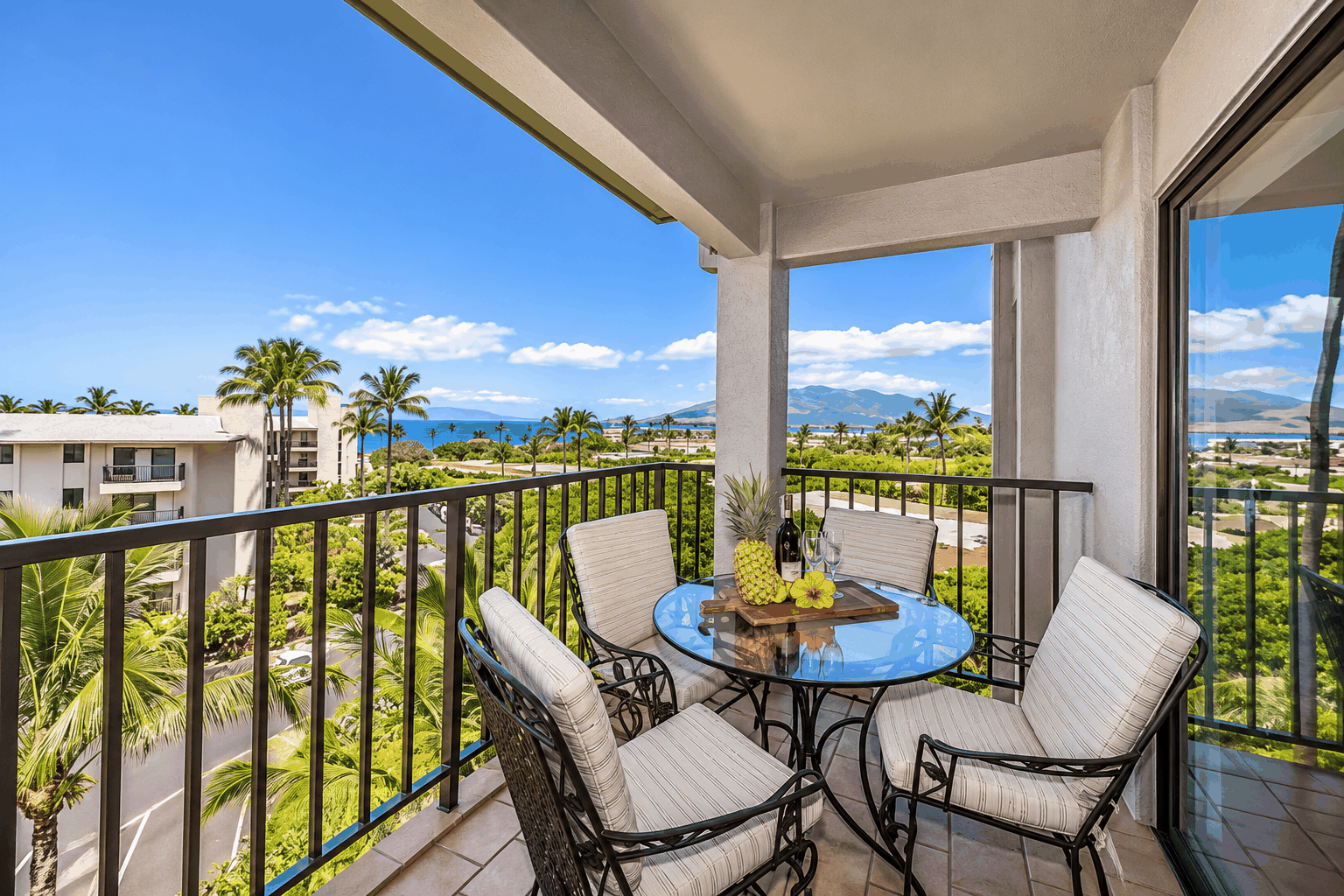
The corner lanai at Kihei Akahi D402, looking out over the palms toward the Pacific and the West Maui Mountains. A remodeled, hotel zoned 2 bedroom across from Kamaole Beach Park II, offered at $925,000.
My contrarian take: the buyers who do best in this reset will be the ones who match the building’s zoning to their rental plan before they fall in love with the view.
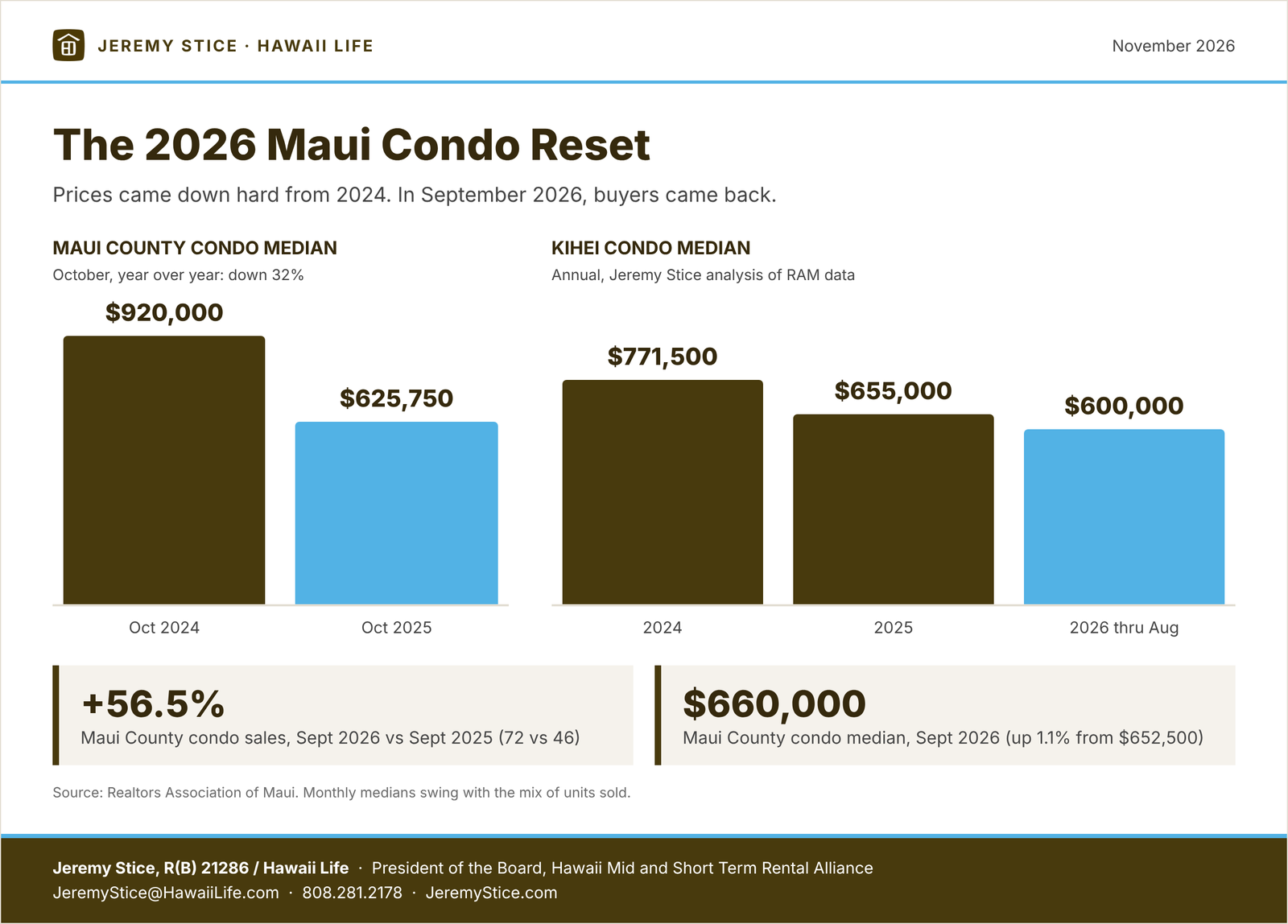
The Maui condo market reset in numbers. The Maui County condo median fell 32% from October 2024 to October 2025, the Kihei median fell from $771,500 in 2024 to $600,000 in 2026 through August, and September 2026 condo sales were up 56.5% from a year earlier. Source: Realtors Association of Maui.
Check the Zoning on Any Maui Condo Before You Pick a Rental Method
On Maui, zoning comes before the rental method, because zoning decides whether you have a rental method at all.
Bill 9 and the Maui Phase Out Deadlines
Bill 9 passed the Maui County Council 5 to 3 on December 15, 2025, and is now Ordinance 5909. It phases out vacation rental use in apartment zoned condos, the so called Minatoya list. The last legal night is December 31, 2028 in West Maui and December 31, 2030 in the rest of the county, including Kihei and Wailea. Hotel and resort zoned properties are not affected.
The county’s 2026 to 2027 property statistics count 6,535 parcels subject to the phase out, 2,220 in West Maui and 4,315 elsewhere.
The H-3 and H-4 Hotel Zoning Path, as of November 2026
Bill 88, now Ordinance 6008, took effect June 22, 2026. It created two new hotel districts, H-3 and H-4, for Minatoya list properties. It did not rezone a single building on its own. Each property still has to be rezoned through a separate process.
Here is where that process stands as of this writing:
- September 2026: the Maui Planning Commission considered 48 properties. It gave unfavorable recommendations to 43, including Kamaole Sands and Papakea, and favorable recommendations to five
- September 29, 2026: the Council voted 5 to 4 to refer 32 more shoreline complexes to the Planning Commission
- October 23, 2026: the Council voted 4 to 5 against referring four more complexes
The Planning Commission’s votes are recommendations. The Council can still approve a rezoning over the Commission’s objection, but that takes six of its nine votes. None of these votes requires any condo to stop taking guests today. The deadlines are what count.
Maui Homes Are a Different Conversation
Very few Maui homes operate as legal vacation rentals, and a short term rental home permit generally does not transfer to a new owner. That is why this post focuses on condos.
Before you write an offer, confirm the zoning and the legal basis for vacation rental use on that specific building with County records please. A listing description is not enough. My full list of hotel zoned condo vacation rentals on Maui is a good place to start.
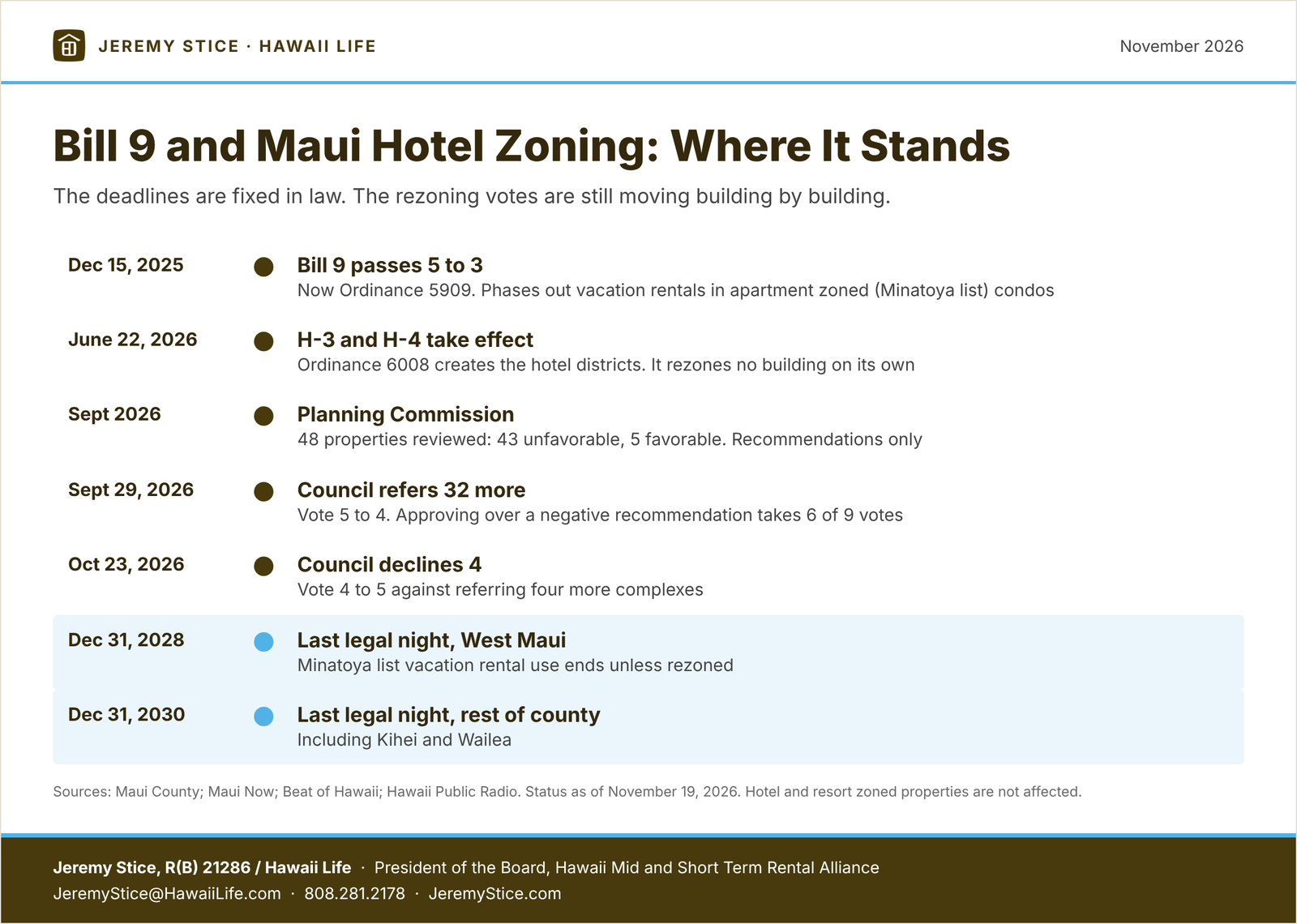
Where Bill 9 and the H-3 and H-4 hotel zoning path stand as of November 2026. The phase out deadlines are fixed in Ordinance 5909, while the rezoning votes are still moving building by building.
A Kaanapali Example Outside Bill 9: Kaanapali Plantation 28, Coming Soon
Zoning is not only hotel or Minatoya. Some Maui vacation rentals sit on other zoning entirely.
Coming soon: Kaanapali Plantation #28, my next listing. It is a 3 bedroom, 2.5 bath, 1,545 square foot town home on the hillside beside North Kaanapali Golf Course, with ocean views from Lanai to Molokai. Kaanapali Plantation is zoned R-2, which Bill 9 does not cover, so vacation rental use remains legal there as of November 2026, and the home is an active vacation rental today. As with any purchase, a buyer should confirm the unit’s rental authorization and association rules during due diligence.
![Covered lanai at Kaanapali Plantation #28 in Kaanapali, Maui, looking over tropical gardens to the ocean]](https://about.hawaiilife.com/wp-content/uploads/2026/11/kaanapali-plantation-28-lanai-ocean-view1.png)
Coming soon: the covered lanai at Kaanapali Plantation #28, looking over tropical gardens to the ocean. An R-2 zoned town home outside the Bill 9 phase out, and one more example of why zoning is the first question on any Maui vacation rental.
The Three Ways to Rent a Maui Condo, Side by Side
Once the zoning checks out, you have three options. Here is how they stack up against the three questions from the top of this post.
![Comparison of Maui resort front desk rental programs, independent managers and self managing, by fees, owner use, customization and involvement]](https://about.hawaiilife.com/wp-content/uploads/2026/11/maui-condo-rental-methods-compared.png)
How the three Maui condo rental methods compare. There is no single best option. The right one depends on your return target, how much you want to use the condo yourself and how involved you want to be.
How Maui Resort Front Desk Rental Programs Work
Front desk programs are still the most common rental method at Maui’s large resorts, though in my experience they have been losing ground to independent managers and the online platforms for more than a decade.
A front desk program runs your condo much like a hotel room. The desk greets guests, handles check in, collects fees and hands out towels and parking passes. Most programs rent by unit category, such as an ocean view 1 bedroom, rather than by your specific unit. That detail drives both the biggest benefit and some of the biggest tradeoffs.
Some buildings mix models. The Whaler in Kaanapali, for example, has an on site front desk program operating alongside independent managers and self managing owners in the same building.

The Whaler in Kaanapali is a good example of a Maui building where owners choose. Some owners rent through the on site front desk program, while others hire an independent manager or rent on their own.
Benefits of a Maui Front Desk Program
- More flexibility for owner stays. Because the program rents by category, it can often move a booked guest to a similar unit so you can use yours. Some owners with more than one unit split them for this reason, putting one in the front desk program for their own use and the others with an independent manager for better returns.
- A faster start. There is no build up period. Your unit plugs into the resort’s existing booking engine and distribution on the day it joins
- Hands off ownership. Operations are standardized, and maintenance staff are on site
Drawbacks of a Maui Front Desk Program
- The highest fees. Front desk program fees typically run 35 to 60 percent of gross rental revenue. Compare the total deductions under each program agreement, including reservation, housekeeping and distribution charges, because the headline percentage rarely tells the whole story
- Less customization. Units are furnished to a hotel standard and are often less equipped than a privately managed condo
- Little incentive to upgrade, unless the program uses rating tiers, such as A, B and C, with different rates for each
- Slow decisions. Requests often go through several layers of corporate management
Maui Complexes With Their Own Management Rules
Some Maui buildings decide part of this for you. Examples from my own deals:
- Some Napili complexes charge owners for personal use beyond set guidelines, because a mandated on site rental entity shares common expenses and income
- Montage Residences Kapalua Bay and Wailea Beach Villas require one exclusive management company or limit outside rental companies
- Hoolei in Wailea, where Megan and I own, gives owners who do not use the on site program a reduced amenity package at the Kulana Club

Montage Residences Kapalua Bay, the oceanfront building at center fronting the Kapalua coastline, with Molokai across the Pailolo Channel. Owners there work within the building’s own management rules, so read them before you write an offer.
Read the association documents and house rules for management restrictions during your review period, please. These rules can choose your rental method for you.
![Wailea Beach Villas on Wailea Beach, Maui, a luxury condo complex that limits outside rental companies]](https://about.hawaiilife.com/wp-content/uploads/2026/11/wailea-beach-villas.png)
Wailea Beach Villas is one of the Maui luxury complexes that restricts which rental companies can operate on property, so the building’s rules shape an owner’s rental options from day one.
Hiring an Independent Maui Vacation Rental Manager
Independent managers sit between the front desk and doing it yourself. They market your specific unit, usually on Airbnb, Vrbo and their own website, and handle guests, cleaning and maintenance.
Benefits of an Independent Maui Manager
- Returns that reward a great manager. Results vary widely by company. In my experience, a new listing with a strong independent manager often earns more in year two than year one, typically 15 to 20 percent more, as it builds reviews and visibility, though that is never guaranteed. That ramp up has been getting longer as the platforms change their rules for new listings, so budget for it
- A choice of service levels. Many managers offer full service and limited service options, and some run hybrid models where the owner handles part of the work
- A real incentive to invest in the unit. Your condo competes on its own photos and reviews, so upgrades show up in your revenue
- A home away from home. Independently managed condos tend to be fully equipped, from the kitchen to the beach gear
Drawbacks of an Independent Maui Manager
- Less flexibility for personal stays. Owners usually give notice or book their own stays through the manager’s owner portal, competing with paying guests for the same dates
- You have to vet the manager. This is a long term partnership, and a bad fit costs you money and reviews
Questions to Ask Any Maui Vacation Rental Manager
- What is the fee a percentage of? Gross rent, rent plus cleaning fees, or net after platform fees? Who keeps the cleaning fee?
- Whose name is on the Airbnb and Vrbo host account? If the manager holds the account, the listing history and reviews usually stay with the manager when you leave. Ask exactly what happens to the listing, the reviews and guest communications if the relationship ends. I covered why that matters at sale time in my post on how Airbnb and Vrbo handle a vacation rental sale
- What are the owner stay rules? Notice periods, blackout dates and any fees on owner stays
- How do I terminate, and what do I owe on future bookings? Many agreements give the outgoing company its full fee on reservations it booked, even after you leave
- Who files the general excise tax and transient accommodations tax returns? Get it in writing
- Can I talk to two owners in my building? Same building, same manager, same season
Self Managing a Maui Vacation Rental in 2026
Doing it yourself gives you the most control and no management fee. Whether that adds up to a higher net return depends on how well the unit books, your operating costs, platform fees and what your own time is worth.
Benefits of Self Managing on Maui
- No management fee. More of each booking stays with you, if the unit books as well on your own
- Real time control of your calendar. You can block your own dates, adjust pricing and approve guests whenever you want
- Freedom to customize. The unit is set up exactly how you want it
What Self Managing on Maui Costs You Now
The economics of self managing have shifted in the last year. Here is what owners are paying in 2026:
- A bigger Airbnb fee. Since October 27, 2025, hosts who connect their Airbnb listings through property management software, such as a channel manager, pay a single 15.5% host only fee. Check which fee structure applies to your account. Under the old split fee model, most hosts paid about 3% and the guest paid the rest
- A higher lodging tax. The state transient accommodations tax rose from 10.25% to 11% on January 1, 2026, under Act 96, the so called Green Fee. The Hawaii Department of Taxation confirms the 11% rate is in effect. On Maui, the 3% county transient accommodations tax and the general excise tax sit on top
- Your own registrations. You need your own general excise tax and transient accommodations tax registrations, and Hawaii requires your TAT registration number in every advertisement, including your Airbnb and Vrbo listings. Penalties for late or missing filings are steep
- Higher property tax on vacation rentals. For fiscal year 2026 to 2027, Maui County’s TVR-STRH rates are $13.00 per $1,000 of assessed value up to $900,000, $15.00 from $900,001 to $3,000,000 and $17.00 above $3,000,000, up from $12.50, $14.00 and $15.55 the year before
What That Property Tax Looks Like on a Real Maui Condo
For illustration, here is what the 2026 to 2027 rates mean for a condo the County classifies as TVR-STRH. Your actual bill depends on the County’s classification and your assessed value.
- A condo assessed at $800,000: about $10,400 a year
- A condo assessed at $1,200,000: about $16,200 a year ($11,700 on the first $900,000, plus $4,500 on the remaining $300,000)
- A real unit: the Hawaii Life listing page for Kihei Akahi D402 reports $13,044 a year in property tax, plus $1,309 a month in association dues. Those two lines alone run about $28,700 a year before a single guest checks in. A buyer’s own tax bill may differ
Self managing pays best for owners who live on Maui or have reliable people on the ground. If a broken lock at 9 p.m. on Christmas Eve means a flight for you, an independent manager is probably worth the fee.
You also need to know and follow current county and state short term rental rules, and the Airbnb and Vrbo cancellation and sale policies, which I broke down in my post on Airbnb and Vrbo sale rules.
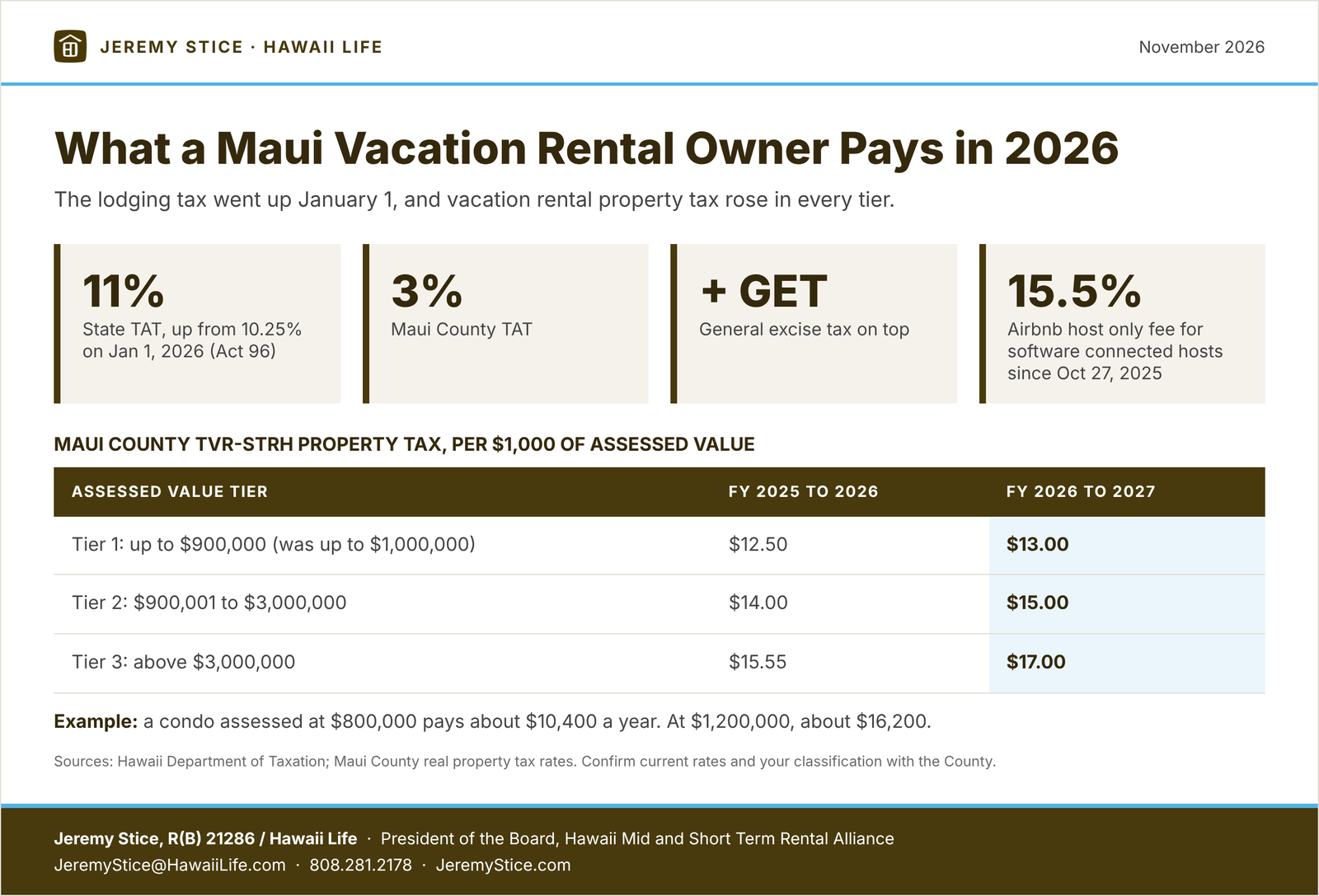
What a Maui vacation rental owner pays in 2026. The state TAT is now 11%, Maui County adds 3% plus the general excise tax, and vacation rental property tax rates rose in every tier for fiscal year 2026 to 2027.
Matching a Maui Rental Method to Your Goals
Back to the three questions from the top. Here is how I usually match them:
- You want lots of personal use and little work: a front desk program, in a resort that has one
- You want the highest return and you live on Maui or can be hands on: self manage
- You want strong returns without the daily work: a carefully vetted independent manager
- You are looking at a Minatoya list building: any rental method’s nightly income ends at the deadline unless the building is rezoned, so underwrite to the date
- You may sell within a few years: pay attention to whose host account the listing lives on, because Airbnb listings and reviews do not transfer with the property
Whatever you choose, line up your management agreement, tax registrations and association requirements during escrow, so the property can start taking guests as soon as it is ready. I walk through the handoff in Part 1 of my series on transitioning a Hawaii vacation rental during a purchase.
Thinking About Buying a Maui Vacation Rental in This Reset?
This is a buyer’s window I would not ignore. Prices have reset, sellers are negotiating and the rules are known.
If you are shopping, start by sending me your three answers please: your return target, your personal use and how involved you want to be. I will match them to buildings where the zoning and the management rules fit your plan, then run the numbers on each rental method before you write an offer.
Ready to start looking? Search Maui condos for sale on Hawaii Life, then send me the ones that catch your eye, please.
Call or text me at 808.281.2178 or email JeremyStice@HawaiiLife.com.
Frequently Asked Questions About Renting Out a Maui Condo
What are the main ways to rent out a Maui condo?
There are three. A resort front desk program rents your unit like a hotel room, usually by unit category. An independent vacation rental manager markets your specific unit and handles guests, cleaning and maintenance. Or you can self manage, handling bookings, guests and taxes yourself or with a few local vendors.
How much do Maui vacation rental managers charge?
Fees vary widely by building and service level. Resort front desk programs generally charge the most, independent managers usually charge less, and self managing owners pay platform fees and their own operating costs instead. Get any management fee in writing as a percentage of a clearly defined revenue figure.
What taxes does a Maui vacation rental owner pay in 2026?
The state transient accommodations tax is 11% as of January 1, 2026, and Maui County adds a 3% county transient accommodations tax, plus the general excise tax. Owners also pay Maui County’s TVR-STRH property tax, which for fiscal year 2026 to 2027 is $13.00 per $1,000 of assessed value up to $900,000, $15.00 from $900,001 to $3,000,000 and $17.00 above $3,000,000.
When do Maui condo vacation rentals have to stop under Bill 9?
Bill 9, adopted as Ordinance 5909, phases out vacation rental use in apartment zoned condos on the Minatoya list. The last legal night is December 31, 2028 in West Maui and December 31, 2030 in the rest of Maui County. Hotel and resort zoned properties are not affected.
What are H-3 and H-4 zoning on Maui?
H-3 and H-4 are hotel zoning districts created by Ordinance 6008, effective June 22, 2026, for Minatoya list properties. They do not rezone any property on their own. Each property must be rezoned separately, and as of November 2026 those rezonings were still moving through the Maui Planning Commission and County Council.
Is now a good time to buy a Maui vacation rental condo?
In my view, this is the strongest buying opportunity for Maui vacation rental condos I have seen in years, for buyers who match the building to their plan. The Maui County condo median fell from $920,000 in October 2024 to $625,750 in October 2025, and September 2026 condo sales were up 56.5% from a year earlier. Minatoya list condos face the Bill 9 deadlines, so confirm each building’s zoning before you buy.
Can I use my Maui condo myself if it is in a rental program?
Yes, though the rules depend on the program and the building. Front desk programs that rent by unit category often make owner stays easier to schedule. Independent managers usually require notice or booking through an owner portal. Some complexes charge owners for personal use beyond set guidelines.
Does Airbnb charge hosts 15.5 percent?
Hosts who connect their Airbnb listings through property management software, such as a channel manager, have paid a single 15.5% host only fee since October 27, 2025. Under the older split fee model, the host paid about 3% and the guest paid a separate service fee.
Mahalo,
Jeremy

Leave your opinion here. Please be nice. Your Email address will be kept private, this form is secure and we never spam you.